Appearance and concept review
 Request a quote
 Rapid prototyping
Home/Solutions/Rapid Prototyping
Rapid Prototyping Services for Functional Parts
Prototype the next useful answer.
Build physical prototypes for appearance, fit, assembly and functional evaluation. We review what the current build needs to prove before selecting the process, material, finish and inspection plan.
A clearer route
Purpose-Led Rapid Prototyping
Early parts may need to validate a form, a mechanical interface, a user interaction or a functional load case. Defining that purpose at RFQ stage helps select the right process, material, finish and delivery target for the next design decision.
Select the route
Prototype Goal and Process Selection Matrix
Fit and assembly check
CNC, 3D printing or sheet metal
Interfaces, tolerance, assembly and material similarity.CNC machined prototypes →Functional testing
CNC, engineering polymer printing or sheet metal
Load, temperature, impact, friction, fluid and lifetime.Sheet metal prototypes →Enclosure or bracket validation
Sheet metal, CNC or printed prototype
Thickness, bend, hardware, interface and appearance.Functional sheet metal prototypes →Pre-molding validation
3D printing, CNC or approved tooling route
Resin behavior, appearance, quantity and tooling decision.Prototype molding route →Keep it visible
Prototype Inspection and Learning Plan
Prototype purpose
State the appearance, fit, assembly or functional question for this build.
Critical interfaces and test conditions
Identify the surfaces, interfaces and conditions that must be reviewed.
Material and finish assumptions
Make the assumptions visible so the result is interpreted in context.
Required measurement or functional check
Agree the measurement, test or review needed for this build.
Decision after review
Use the result to revise, repeat, start a pilot build or release the next route.
What stays in view
Make the next build more useful.
Purpose-led selection
Choose a route around what the prototype must demonstrate—appearance, fit, assembly, motion or functional evaluation.
Fast learning, not false certainty
Material and finish assumptions are made visible so a quick result is useful in the right way for the current stage.
A route forward
The prototype can inform a clear hand-off to CNC machining, sheet metal, injection molding or a repeatable low-volume order.
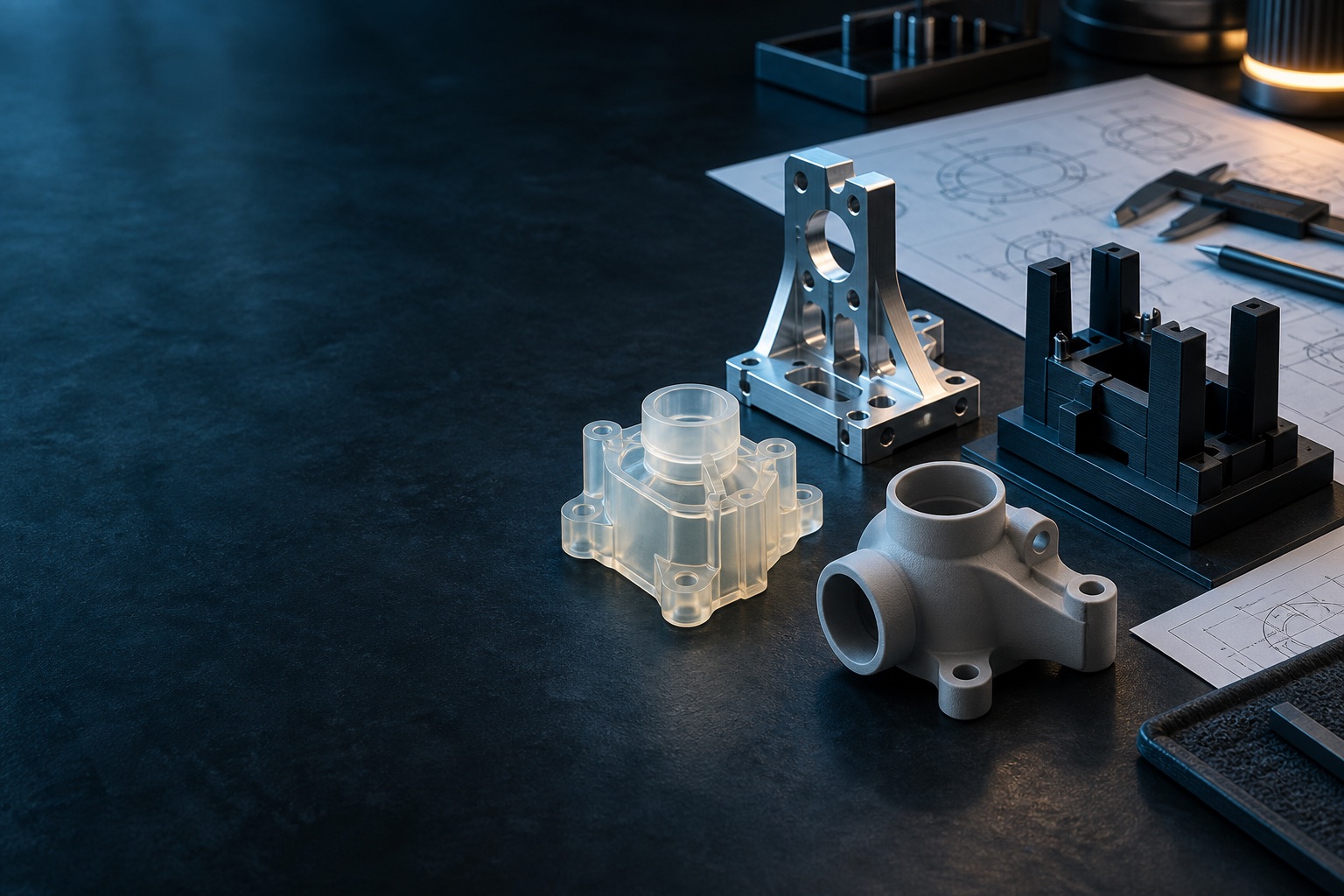
Typical applications
Built for the work between a screen and the next revision.
- Concept and appearance models
- Fit-check and assembly-trial parts
- Functional prototypes and interface hardware
- Jigs, fixtures and test aids
- Small evaluation sets for engineering review
A single project can use more than one process when the team needs to evaluate different questions at the same time.
Request a prototype quoteRequirements at RFQ stage
What makes a prototype RFQ more useful.
- 01The current 3D model and drawing revision
- 02What the prototype needs to prove in this build
- 03Required quantity and delivery date
- 04Critical fit, motion, load-bearing or cosmetic features
- 05Preferred material, finish or production-material behavior
- 06Inspection, test and reporting requirements
- 07Delivery destination and the expected next project stage
From drawing to decision
Turn the prototype brief into a clear next step.
- 01
Name the learning goal
Explain whether the part is for visual review, fit, function, assembly or another engineering question.
- 02
Share the current design
Send the model and drawing where available, including interfaces and surfaces that matter.
- 03
Review the proposed route
We make the process, material, finish and delivery assumptions visible in the quotation.
- 04
Use the result
The part is delivered for the stated purpose and can inform the next revision or manufacturing route.
Your next project
What to Include in a Prototype RFQ
Share the current revision, material, quantity, delivery target and the requirements that matter for this build. We’ll review the information before responding.
READY TO QUOTE
- Current 3D model and drawing revision
- What the prototype needs to prove
- Quantity and delivery date
- Critical fit, function or cosmetic features
- Material, finish and inspection needs
- Delivery destination and next project stage